
Upper School Program
Preparing Students for Greater Independence
Upper School provides individualized academic, social-emotional and life-skills instruction that helps students build confidence, independence and readiness for their next environment.
Our multidisciplinary approach meets students where they are and supports meaningful progress toward individualized goals.
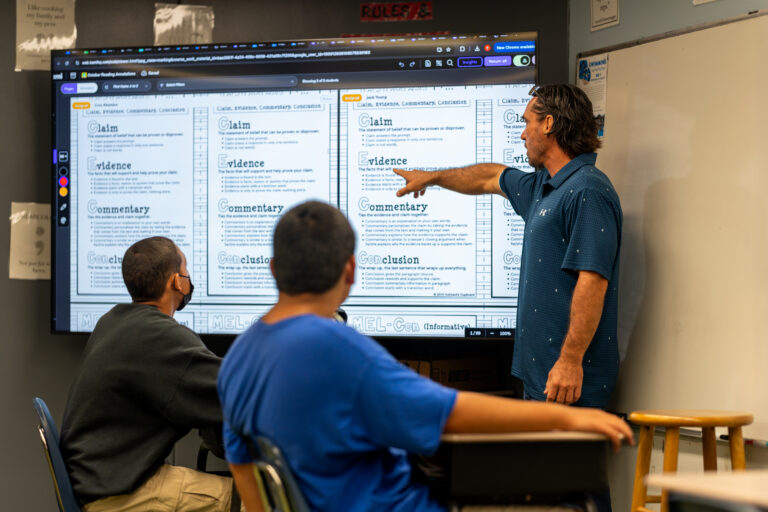
Three Pathways for Student Growth
Programming is aligned with each student’s current skills, goals and readiness for greater independence.
Foundations: Building Foundational School Skills
- Experience challenges with transitions, task initiation, or sustained engagement
- Require support in following directions, accepting feedback, and completing tasks independently
- Need guidance in managing emotions, navigating conflict, and participating appropriately in a group
- Be developing self-awareness, accountability, and appropriate communication skills
Fundamentals: Students Developing Academic and Communication Independence
- Rely on prompts or adult support to complete tasks or follow instructions
- Experience difficulty processing information, initiating conversations, or seeking help
- Be working toward stronger engagement across academic, social, and community settings
- Be developing the ability to reflect, communicate effectively, and sustain effort through challenges
Pathways: Students Preparing for Transition Beyond School
- Need support with decision-making, self-advocacy, and confidence
- Be developing the ability to follow multi-step directions and process complex information
- Be working toward greater independence in communication, problem-solving, and daily functioning
- Benefit from guidance in social awareness, community navigation, and workplace readiness
Our Approach
Across all programs, we focus on helping students:
Develop independence and self-direction
Build effective communication and social skills
Strengthen resilience and motivation
Gain the academic and life skills necessary for their next step
We recognize that each student’s path is unique, and we are committed to supporting their growth toward meaningful, individualized outcomes.
- Require intensive behavioral or safety interventions, including:
- Frequent or unpredictable elopement (leaving supervised areas without permission)
- Ongoing physical aggression toward self or others
- Behaviors that pose a consistent risk to the safety of the student or others
- Require significant support with personal care, including:
- Inability to independently manage toileting and hygiene needs, including menstrual care
- Medical or personal care needs that require dedicated nursing or specialized staff beyond our capacity
- Demonstrate patterns of behavior that significantly impact the safety and well-being of others, including:
- Repeated engagement in inappropriate or harmful sexualized behavior
- Involvement in substance use (drugs or alcohol) that interferes with participation in a school setting
- Require a higher level of therapeutic, clinical, or crisis intervention support than can be provided within a school-based program
Students We Are Unable to Support
Variety School is committed to serving students whose needs align with the structure, staffing, and support of our program. At this time, we are not equipped to safely or effectively serve students who require a level of supervision, intervention, or care beyond what our program is designed to provide. This may include students who:
What We Offer
Variety School provides a structured, supportive, and individualized learning environment designed to help students grow academically, socially, and emotionally. Through a multidisciplinary approach, we focus on developing the skills students need to become more independent, confident, and prepared for their next step.
Individualized Instruction
Structured and Supportive Environment
- Follow directions and complete tasks independently
- Participate appropriately in group settings
- Accept feedback and take responsibility for their actions
Social and Emotional Development
- Effective communication and self-advocacy
- Conflict resolution and perspective-taking
- Emotional regulation and resilience
Skill-Building for Independence
- Task initiation and completion
- Problem-solving and decision-making
- Sustained attention and work stamina
- Intrinsic motivation and self-direction
Transition-Focused Programming
- Apply skills across settings
- Navigate community and social expectations
- Build readiness for increased independence and responsibility